
Dual-Task Overload and Neural Adaptation in Youth Football Development

Quick introduction
Most football training looks neat in practice, but then breaks down in matches. The reason is simple: many drills only train technique in isolation without preparing the brain for the chaos and divided attention of the real game.
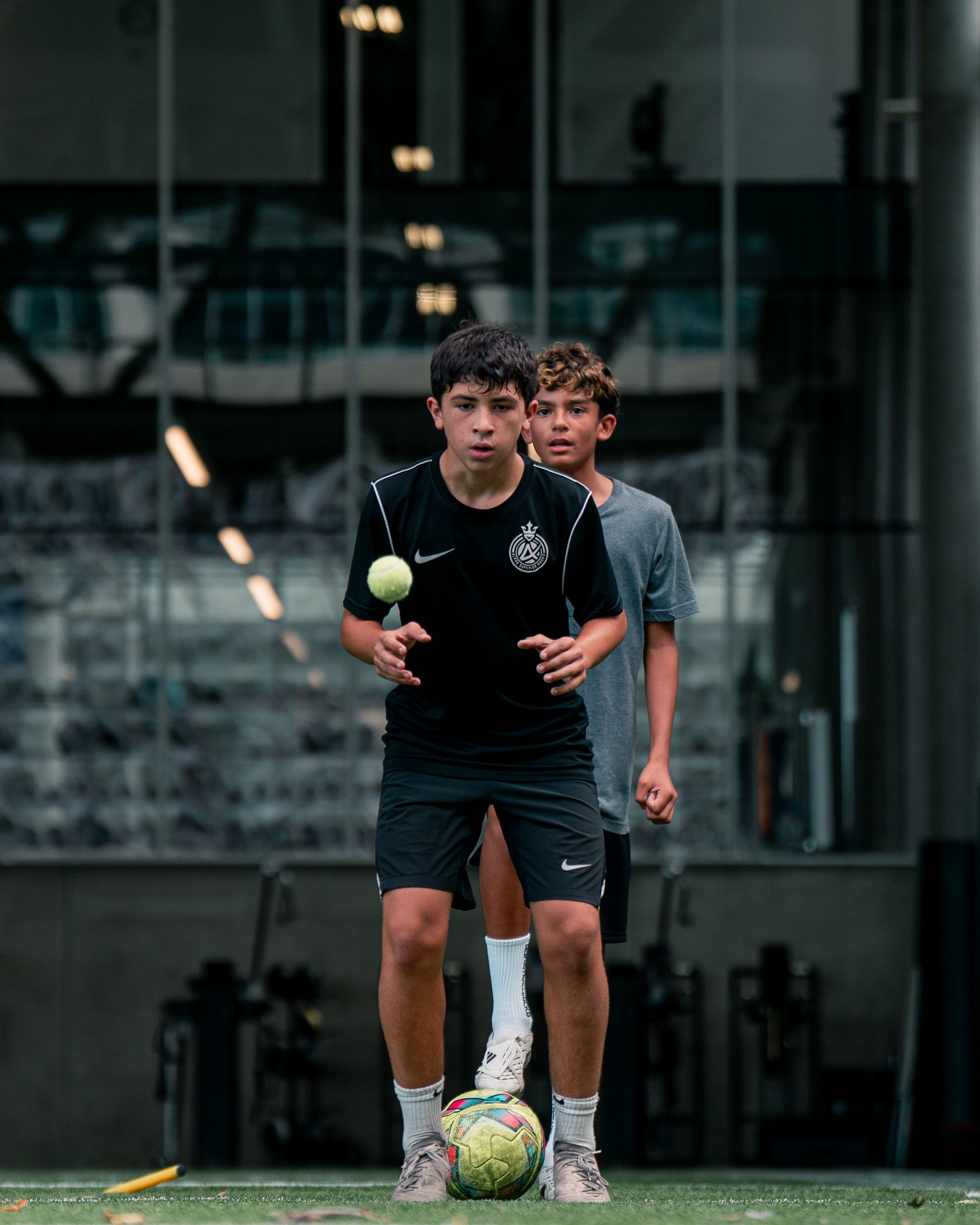
This white paper explores how dual-task overload training pushes players to adapt in messy, error-filled environments. The struggle you see on the training pitch is not failure. The brain is learning to become faster, calmer, and more resilient. In this paper, we explain why this approach is scientifically sound and why it is central to the Forms Academy methodology.
For parents and coaches who want to go deeper, continue the discussion, and see how we train these concepts day-to-day, join us inside Forms Football Skool, where this paper is paired with lessons, discussions, and applications.
Dual-Task Overload and Neural Adaptation in Youth Football Development
Introduction
Football is not played in neat, isolated patterns. It is played in chaos. Players must dribble while scanning, anticipate while moving, and make decisions while under pressure. Yet most youth training continues to separate technique from cognitive demand. A child dribbles cones without pressure, passes against a wall without distraction, or rehearses patterns that never change. The outcome is players who look polished in training but fragile in matches.
At Forms Academy, we approach development differently. We deliberately create training environments where attention is split, errors are frequent, and execution feels messy. This method, known as dual-task overload, forces the nervous system to adapt to conditions that look more like the game itself. It is not about looking perfect in practice. It is about rewiring the brain for resilience, anticipation, and composure.
Why Messiness Matters
Parents often ask, “Why does training sometimes look so chaotic?” The answer is simple: because football itself is chaotic. Neuroscience tells us that the brain grows through struggle. When players freeze, hesitate, or make awkward mistakes, their nervous system is being pushed beyond its comfort zone.
This is called productive strain. It occurs when working memory, attention, and motor control are overloaded simultaneously. The brain cannot yet handle the demands, so errors occur. But those errors are signals, not setbacks. They are evidence of neural systems trying, failing, and adapting. Over time, the very moments that looked like breakdowns become the building blocks of fluent performance.
In other words, the “messy” practice you sometimes see is not a flaw. It is the process of growth in action.
The Science of Dual-Task Training
Neuroscience has long shown that the brain reorganizes itself when challenged to manage competing demands. Several systems work together in this process:
The motor cortex issues commands for precise movement.
The cerebellum coordinates timing and rhythm, constantly correcting errors.
The basal ganglia manage sequencing, deciding which actions to release and which to suppress.
The prefrontal cortex governs attention and working memory, trying to track multiple tasks simultaneously.
The parietal cortex integrates spatial awareness, making sense of the body, ball, and environment.
When players are asked to perform two tasks simultaneously, such as controlling the ball while managing another demand, these systems compete for resources. At first, performance declines. Players freeze, mis-sequence, or lose precision. But with repetition, the brain adapts. Tasks that once required full concentration become automatic, freeing up bandwidth for higher-level functions like scanning and decision-making.
This is why dual-task overload is so powerful. It not only strengthens technical skills but also develops the brain’s ability to manage them under match conditions.
Short-Term Benefits
Even after a few weeks of this type of training, changes are visible:
Players become more aware of their mistakes and correct them faster.
They grow more confident using their weaker foot, because they cannot avoid it under overload.
They begin to focus better in chaotic situations, learning not to panic when things get messy.
These are small but critical shifts. They show that the nervous system is already adapting, even before the deeper, long-term changes take root.
Long-Term Adaptations
Sustained exposure to dual-task overload produces profound neuroplastic gains:
Automaticity: Skills move from conscious effort to effortless fluency, allowing players to scan and anticipate while still executing cleanly.
Bilateral mastery: Repeated stress on the weaker foot closes the gap between dominant and non-dominant sides, giving players more options and unpredictability.
Resilience under pressure: Players learn to sustain performance even when attention is divided or stress is high.
Anticipation: The brain shifts from reacting to predicting, enabling players to see opportunities before they fully open.
Composure: Training in error-rich environments builds tolerance for mistakes, leading to calmness in matches.
These are not theoretical gains. They are the traits that separate average players from elite performers.
Why This Matters for Youth Football
The most critical years for development are the years when the brain is most adaptable. Research shows that sensitive periods in childhood and adolescence are when coordination, motor control, and attention systems are most responsive to training. If these years are spent only on clean, isolated drills, opportunities for deeper growth are missed.
At Forms Academy, we believe the opposite approach is required. Training must sometimes look messy. It must overload attention, force weak-foot use, and demand fluency in chaos. Only then will players be prepared for the realities of competition.
Conclusion
Dual-task overload may not always look impressive from the sidelines, but it is one of the most scientifically sound methods for long-term player growth. By deliberately embracing chaos, we help players build the resilience, anticipation, and composure they need to thrive in high-level football.
This is not about making training harder for the sake of it. It is about aligning development with how the brain actually learns. The mistakes you see are not setbacks. They are the signs of adaptation.